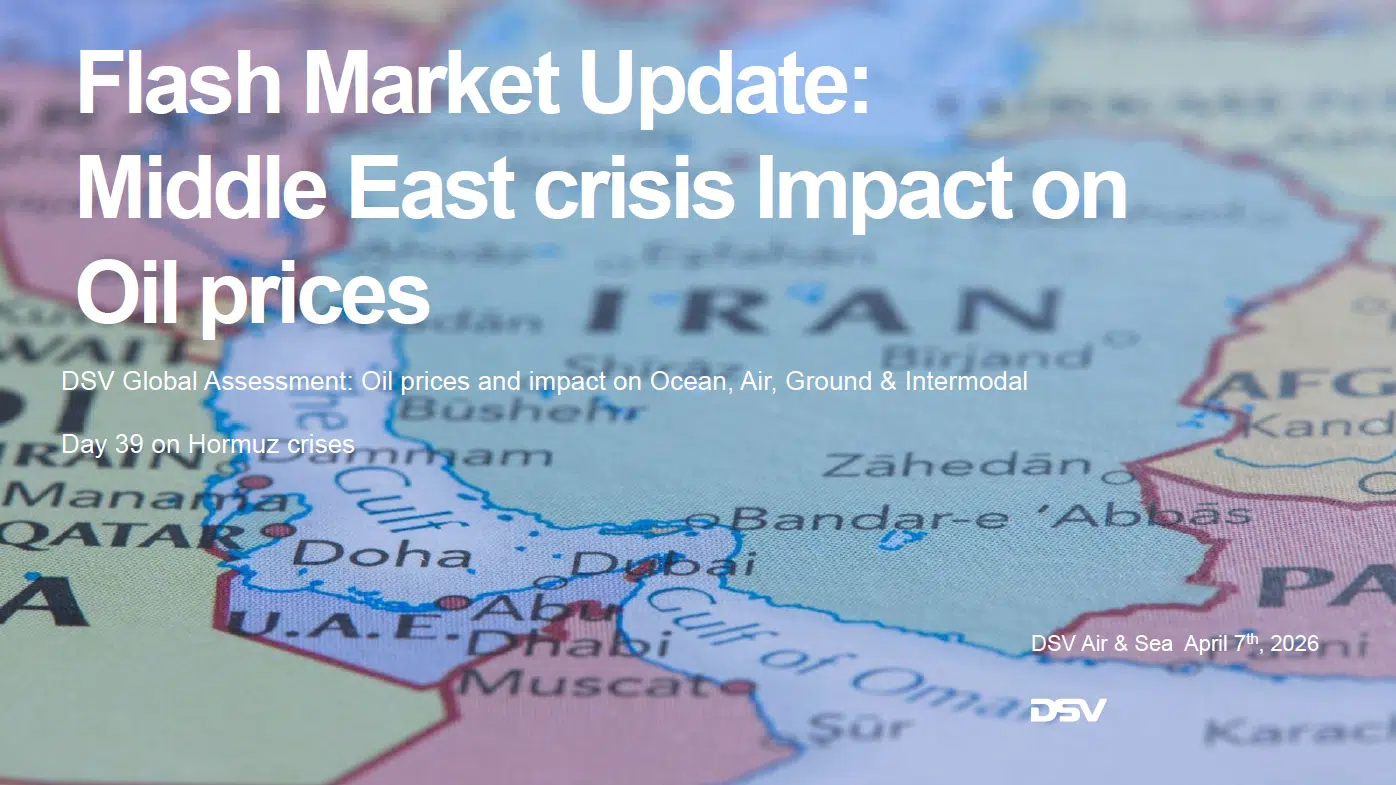
Middle East Crisis Update: Impact on the Supply Chain
Dear Customers,
The continued escalation of the Middle East conflict and the prolonged closure of the Strait of Hormuz are reshaping global energy and transport markets in ways that have no recent historical parallel. With over than 39 days of the Hormuz disruption now behind us, we want to provide you with a clear, fact-based overview of what is happening, and how it affects transport costs across Ocean, Air, and Road.
Crude oil prices alone no longer explain what is happening in fuel markets.
Marine bunker, jet fuel, and road diesel are no longer moving in sync with crude, because each of these refined products depends on different regional supply chains, refinery configurations, and now heavily disrupted shipping corridors.
Why have transport fuels decoupled from crude?
- Marine bunker fuel (VLSFO): Prices in Asia have increased far more than crude due to reduced refinery output in key producing countries, and limited regional availability.
- Air Jet fuel: The largest shock across all transport fuels. Jet fuel does not just follow crude; it follows refinery output. With Gulf refineries unable to export through Hormuz, global jet fuel crack spreads have surged to record levels, pushing airline operating costs sharply upward.
- Road diesel: Diesel markets have diverged by region. Government caps in parts of Europe temporarily mask the true increase, whereas the US and parts of Asia are seeing rapid price jumps driven by refining bottlenecks.
What this means for freight costs?
The current increases in transport costs are not driven by traditional supply-and-demand dynamics, but by fuel-specific disruptions across three major corridors: Hormuz, the Red Sea, and now emerging constraints around Panama. This means that even if freight demand softens, rates can continue rising because the primary cost driver is fuel, not volume.
Why this report matters?
- Understand the structural changes underway in global fuel markets.
- Recognize why BAF, FSC, and road fuel surcharges are rising at different speeds.
- Anticipate how prolonged disruption in the Strait of Hormuz may prevent prices from returning to pre‑February levels for some time.
- Position your supply chain strategies, accordingly, including budget planning, routing choices, and contract considerations.
The goal is to offer transparency, clarity, and timely insights so you can make informed decisions in an environment that continues.
Our teams at DSV remain at your service for any inquiry or request.
For additional information, please contact us at: info@il.dsv.com
DSV ISRAEL

Special project transport
Out of gauge and anything non-standard
Special project transport
Out of gauge and anything non-standard
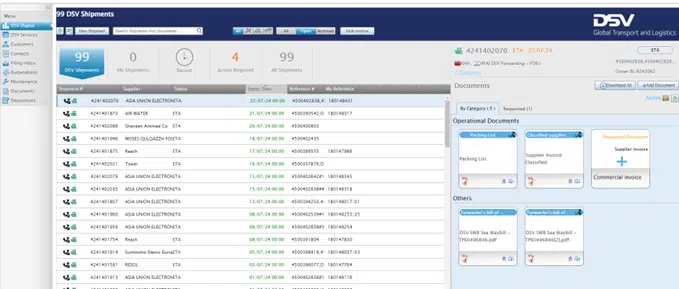
Special project transport
Out of gauge and anything non-standard
Special project transport
Out of gauge and anything non-standard
Special project transport
Out of gauge and anything non-standard
Special project transport
Out of gauge and anything non-standard
Special project transport
Out of gauge and anything non-standard
Special project transport
Out of gauge and anything non-standard
Special project transport
Out of gauge and anything non-standard
Special project transport
Out of gauge and anything non-standard
Special project transport
Out of gauge and anything non-standard
Special project transport
Out of gauge and anything non-standard
Special project transport
Out of gauge and anything non-standard

Time Critical Services
When it’s urgent and you need something delivered fast
Special project transport
Out of gauge and anything non-standard

Rail freight
The greener alternative from China to Europe and within Europe and North America

Road transport
Local, long distance, national or international

Sea freight
When cost matters and time is not an issue

Air freight
When time and speed matter most
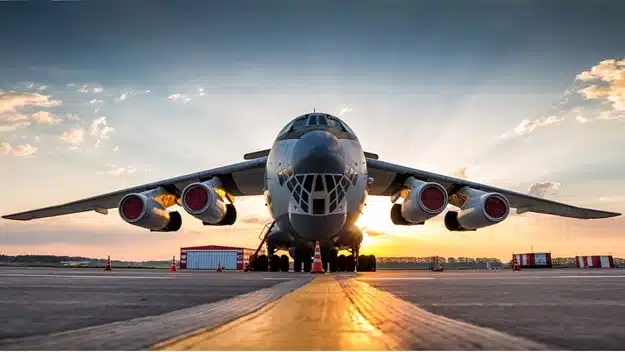
Air freight
When time and speed matter most
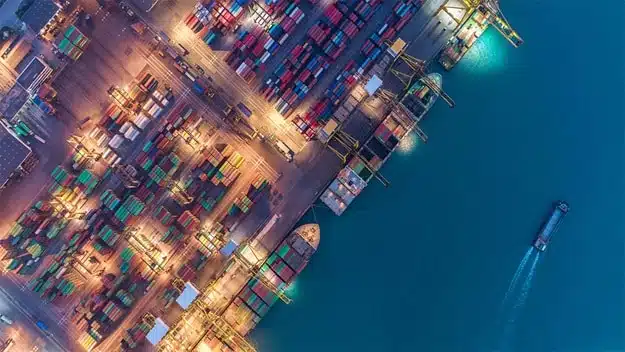
Sea freight
When cost matters and time is not an issue
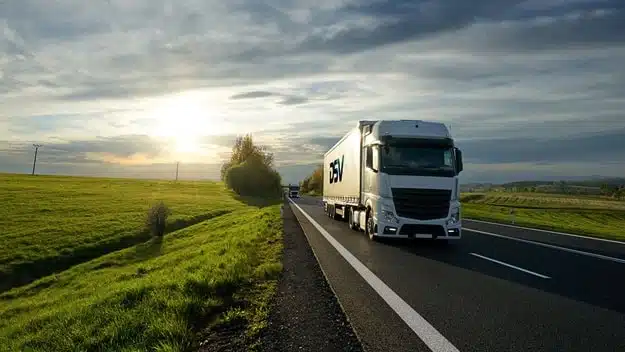
Road transport
Local, long distance, national or international

Rail freight
The greener alternative from China to Europe and within Europe and North America
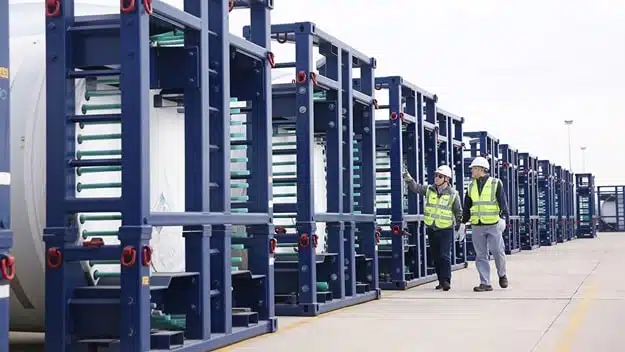
Special project transport
Out of gauge and anything non-standard

Time Critical Services
When it’s urgent and you need something delivered fast

הפקת דוחות פליטות פחמן
יעוץ תכנון וניהול פרויקטים רחבי היקף בארץ ובחו”ל
Latest news

Airline Status as of 13/04/2026

Flash Update 12/04/2026
Correction – Hazardous materials transport update
Flash Update 09/04/2026
Update – Implementation of Fuel Surcharge as of 01/04/2026
31/03/2026 Ocean carriers – Breakdown of fuel and war-related surcharges

Flash update – 30/03/2026
Flash update – 29/03/2026
Flash update – 26/03/2026
Flash update – 24/03/2026
Ocean carriers – Breakdown of fuel and war-related surcharges